Showing posts with label horse. Show all posts

Wednesday, August 21, 2013

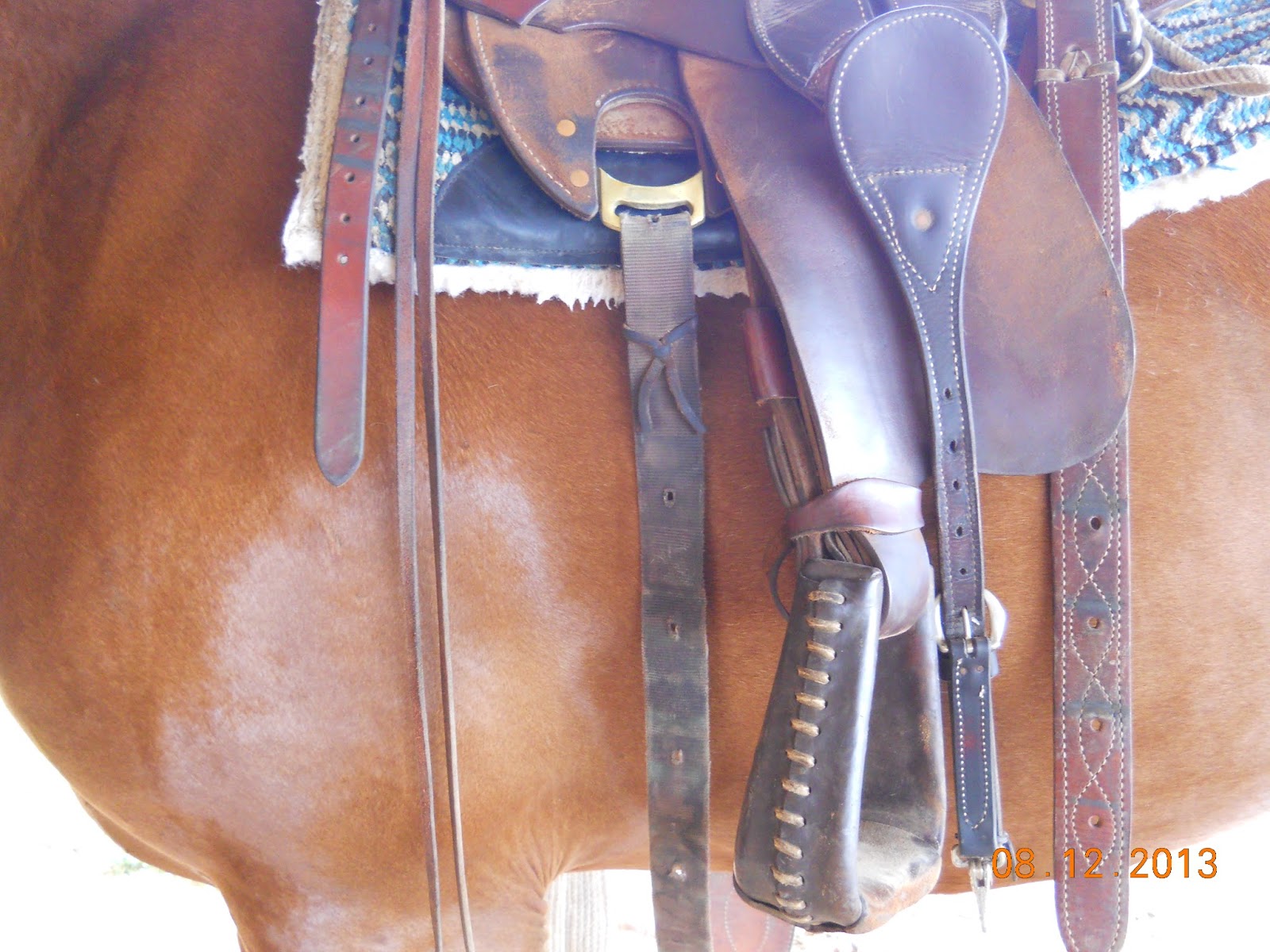
Latigos and Cinches: how to store them so that they're handy and out of the way

This is something that I've seen a lot over the years and it always sort of bothered me because there is a much easier way to do things.  I see folks unsaddle their horses and leave the cinches just hanging down so that they'd drag on the ground whenever they carry the saddle.
 
 
I guess that's all well and good if you don't mind tripping over your cinches while you're walking or getting them all dirty and having them pick up stickers and such from being drug around.
 
 
I've also seen a lot of folks that just throw their sweaty ol' cinches up over the seat of the saddle like this

But with this, you're getting all that sweat soaking into the jockeys and seat of your saddle.  It can discolor the saddle where the cinch lays and, if the leather is not cared for properly, the constant exposure to such salty moisture can cause the leather of the saddle to break down.

Personally, I prefer to keep them looped up and use the keeper on the off side of the saddle that was made for this purpose. 

 
This keeps them out of the way when I'm carrying my saddle and it also makes swinging the saddle up there much easier because I don't have to fumble around and pick them up and get them out of the way first.


Another thing that's pretty commonly seen is the latigo just slung up over the saddle like this or having it just left down to hang and tangle around your feet as you're walking.  In my opinion, this makes saddling up more of a pain than it needs to be.

So, I'll show you how I keep my latigo up and stored where it's out of my way and is extremely easy to cinch up when I'm saddling my horse.


Here, you've got the latigo just hanging down loose, the way it would be just after you undid your cinch.

I'll grab it about halfway down and bring that point up behind the rigging


Then, I'll take that point that I've got ahold of and bring it up through the ring on the saddle.


I pull it up and through and adjust the entire thing until all of the layers are an even length


 Then, I just let it lay down and it's hanging in a nice, convenient, out of the way manner
 
 
Then, when it comes to cinching up, I basically just do the opposite.  I'll grab the tail of the latigo, which is at the very back of the layers, closest to the horse.  I take it down and put it through the ring on my cinch.


Then, it's just as simple as pulling out the slack


After that, you just proceed to cinch up normally.  When you're done, you just put the latigo and cinches up again and they are already stored for easy carrying and use the next time you pull your saddle out.

Depending on the fence and stressing trivial stuff before you get the important things down

One of the most common problems I've found in dealing with horses that have already been through one trainer is that they are seldom, if ever, ridden outside an arena/pen.  For that reason, those trainers don't realize how much they depend on the fence to control the horse they are riding.

For example, I'm currently riding a 4 year old mule that had been to another trainer, had 50 saddlings, and had never seen the outside of a roundpen.  That is also a perfect example of the trainer and owner not communicating enough to come to a happy conclusion for both of them.  The owner was wanting a nice, broke mule that he could take out and enjoy trail riding on.  The trainer, in spite of having rode the mule 50 times, he never once took the mule anywhere even remotely resembling a trail, he spent so much time on teaching her to move around with her nose tucked up to her chest in a correction bit (which he started using on her 3rd ride...but that's another story) that she has a mouth about as soft as a cinderblock, has no idea what "stop" means, and has been taught very well that she doesn't have to follow her nose....so she's perfectly happy to lope along with her nose pointing right and her body going left.  Now, that wouldn't be such a horrible thing if it was trained as a counterbending exercise like you see in reining horses, but this mule also has no idea what leg cues mean so there is no controlling her body with your legs.

Another thing I've noticed is that any time she gets even remotely stressed, which is almost constantly, she starts grinding her teeth.  That's another symptom of having been ridden by someone who wanted her "bridled up" before she was ready for it...and as a result, even slightly picking up pressure with the reins results in instant stress to her.

Because she has always depended on a fence to "keep her in a circle", she has no idea how to obey the commands of the rider on her back to maintain her direction.  I've been dealing with a very dangerous situation with this mule.  When she first came here, she had no idea what lateral flexion was.  Her neck was about as stiff as a steel pipe.  I've fixed that and basically got her listening well at the trot and walk but she has a panic attack when it comes time to lope, especially if I ask for a circle.  She'll go along okay for half or maybe 3/4 of the circle and then she'll decide that she wants to go the other way...so in spite of me picking up on the inside rein to try to correct her direction, she continues to lope off in the direction she wanted to go.

And, to top it all off, she's barn sour so she always knows which direction the barn is and that's the way she wants to lope sideways toward.  I truly feel sorry for this poor mule every time I mess with her.  She's been jacked around and screwed with and micromanaged so much that she honestly has no idea how to just be happy under saddle.  Even now, she can't sit still for more than a minute or so before she starts stressing about what's about to happen so much that she basically panics and begins either backing up or walking off forward or sideways.  I've been working with her and she's getting better but there is still a very long way to go.

Update:  The first part of this post was written about a year ago and then I just sort of forgot about it until now.

I sent this mule home about 30 days after writing the previous part.  It took a lot of time and a lot of patience, but she finally clicked onto the fact that being ridden could be fun.  I just took her a few thousand miles and whenever she would follow her shoulder, I'd just gently bump with outside leg and lift on the inside rein until she straightened out again.  I learned that she responded badly to having anyone get after her and increase the pressure....so I didn't.  I'd keep the pressure steady until she responded. 

At first, it would take up to a couple hundred yards of travelling crooked and sideways, but it steadily got shorter and shorter.  One day, she just quit doing it altogether.  After that, circles were basically a breeze.  The first time I asked for a canter on a circle, she had a momentary flashback and started to get tense and noodle-y through her body, but I just kept my energy down and kept light pressure on and she quickly relaxed and was loping calm circles in just a few minutes.  I was really happy with her when I sent her home.

Tuesday, May 8, 2012

Teaching "Cruise Control"

Now, I am not a western pleasure trainer. I simply train good horses that are calm, consistent, and controlled. My Dad trained show horses back in the day before the peanut roller fad and he trained his share of champion WP horses and what he learned riding them is what he passed on down to me.

I don't like a horse to creep along like he's bordering on death with his nose hanging between his knees, but I do like for a horse to go along easy with their head level and relaxed. What this post is about is describing how I acheive that collection and cadence on a normal riding horse.

The first and most important thing is to get the horse moving with impulsion. If you start trying to really control their speed before they are comfortable moving out, then you'll end up with a confused horse that has no idea what collection is. Get them moving soft and flat at all 3 gaits before you ever consider adding cruise control.

The way that I get them flat is to "lope them until their head drops". Some horses take longer than others to realize this, but sooner or later, they all do. What I do is work them in circles and lope them on a loose rein until they realize that speed is going to get them nowhere. What I do is use one rein to control their speed a bit.  If they start charging around at a dead run (which does sometimes happen), then I just pick up the inside rein and spiral their circle down to the point that they have to slow down to keep their balance.  Once they slow down, then I slowly spiral them back out into the bigger circle.  If they start speeding up again, I spiral them back down.

Eventually, their topline will flatten out and they will slow down on their own. When they are consistently picking up and maintaining that flat, easy gait each time you ask for it, then you are ready to start working on controlling that speed.

Now, this can either be done in an arena while working circles or out on the trail. I prefer to do both just to keep the horse well rounded and keep them from getting too set in working in just one environment.

What I do is start out at the walk. I'll let them free walk on a loose rein for 4-6 strides, then I'll ask for the stop and immediately ask for 3-4 steps of a backup. When you ask them to back up, you need to make sure to ask them to stay round and supple. If they brace or hollow out, then keep the pressure and keep asking for the backup until they do soften and round up the way that they should. After I've gotten a couple of really nice backward steps out of them, I'll keep light pressure on the reins but allow them to stop moving their feet. I'll hold them there for just a minute in the rounded and level frame. If they seem willing to hold it by themselves, I'll let the pressure off the reins and only bring it back up if they change their head position.

I'll do the walk/stop/back up/hold/sit routine over and over and over until I can feel them looking for that stop. What it feels like is a small hesitation with each step. Once they are consistently doing a controlled cadence and speed at the walk, then I move up to the trot and start over; trot/stop/back/hold/sit/trot/stop/back/hold/sit, etc. Once they are solid at the trot, then I move up to the lope and start over again. It may only take a couple of sessions at each gait or it may take a couple of weeks of sessions at each gait before the horse starts to get really consistent.

Once the horse has begun to show consistency in a given gait, then I'll start lengthening the stretch I allow them to move before asking for the stop. That may be 5 strides, it may be 50, the horse will learn and get consistent in his own time. When he's consistent, I allow him to just keep on going and the only time I stop/back/hold is when he changes his frame or cadence; raises his head, hollows out, speeds up, etc.

What this does is gets a horse to constantly think "stopstopstopstop", it shortens their stride, slows their gaits, gets them working off their hind end, keeps their headset level, and teaches them to be consistent in their gaits. A horse doesn't run around at mach 3 with his head in the air if he's looking for a stop and he's been taught to stop properly.

The most important word here is properly. In order for this method to be successful, you have to get the horse working properly and using his body properly first. If the horse is moving forward hollow and strung out with his head in the air and he's moving backward hollow and strung out with his head in the air, then all this will do is get him stopping hollow and strung out with his head in the air.

Now, another thing to mention is that you don't necessarily have to do this at a walk, especially if you are like me and prefer a horse that will really walk out and cover some country. You can work it starting at the trot, but it usually takes a bit longer for them to get consistent if you don't start at the walk first. What I normally do is teach this at all 3 gaits and then go back and teach them to do that nice running walk. That way, you have the slow walk when you want it, the fast walk when you want it, and still have the control at the other gaits as well.

It can be really nice to have a horse willing to poke along on a leisurely trail ride with friends then immediately step up the pace and cover country without changing gaits. My main horse that I ride right now can reach out and walk and then I can ask for an easy jog and he doesn't change ground speed at all, just maintains that speed in a different gait. I really like that because his jog is really smooth and sometimes I want to ride it instead of the running walk.

Anyway, that's my rundown of how to get a horse "working with his brakes on".

Thursday, July 28, 2011

Sitting still

No one should ever underestimate the usefulness of just sitting still on a young horse. It is easy to overlook that they need to learn that just like they need to learn how to turn and stop. One of my favorite things to do is, right in the middle of a workout, I will just stop them and let them stand there still for quite a while, sometimes 10-20 minutes or more and just do things that you want them to stand still for. I'll move my legs, re-adjust my seat, move my hands and re-adjust my reins, jiggle the breast collar and back cinch, reach up and scratch them on the neck, reach back and scratch/pat them on the butt, move my weight back and forth and make the saddle move, etc. The last thing I want to happen is I send a horse home and find out the owner ended up falling off because they reached back to pet the horse's butt and it spooked from that or boogered sideways when they leaned forward to pat them on the neck.


When I want them to move forward, I make sure that I am very clear about the forward cue; equal leg pressure on both sides, a forward seat, and I will move my rein hand forward closer to their head on green horses for the first few times until they are solid on just legs and seat. There are very few things that get on my nerves quicker than a horse that just won't stand still.

Sometimes they don't want to stand still, that's okay. If they walk forward, I'll turn them in little circles 'til their feet stop or back them up a few steps, then I let them stop again. It really helps if they are pretty worn out first because, let's face it, most green horses have attention issues right when you first get on anyway and asking them to just stand there and be still for an extended period of time is about like asking a kid for the same thing at a birthday party, haha. Of course, they need to stand until you ask them to move, but if you keep the first few sessions short, then you are setting them up for success.

My favorite time to do it is right in the middle of loping/trotting circles. That way, they can learn that sometimes they will be required to go from higher speed to a standstill and getting to just stand there and breathe for a minute is nice. Horses that appreciate the moments of stillness are ones that don't prance around, even when other horses are milling around. They may keep an eye on all the activity, but they will keep their feet still.


In my experience, that is the one thing that most people want and so few of them have; a horse that is content to just stand there while you talk to a friend or watch a rodeo event. Or, even more importantly, stand still while you mount and get comfortable and when you dismount.

Tuesday, January 26, 2010

Working with baby.

I am currently involved in my first experience with handling a foal. I have always had untrained horses to handle but never one younger than 2. Rafe was born on July 16, 2009 to a Belgian mare that we "rescued" from a friend of ours so that he wouldn't just send her to auction. Most people who know anything about the horse market would be able to tell you exactly what a green broke, 7 year old, fugly Belgian mare that was in foal to a Quarter Horse would have been worth at auction. So to keep her out of the kill pen, we brought her home. I guess in a bad way, it was fortunate that Steph (John's mate) had been snakebit and died in November '08 cause then John needed a mate to go into harness with. If we hadn't needed another VERY large draft, poor Bessie would have never found a home with us. Anyway, back to the point at hand.
I had never handled a baby before Rafe was born so I had some learning to do along with him. I was able to get there the evening of the day that he was born and do some imprinting, luckily, Bessie was cool with that an didn't interfere. She just stayed close by. Every day I was able, I would go out and just work on scratching him and petting him and getting him used to being handled. As the weeks and months progressed, he demonstrated that he had absolutely no fear of humans and apparently had inherited his mom's laid back temperment. The only problem was that he was beginning to be disrespectful like most foals will at some point. He became nippy and would invade your personal space, step on your toes, etc. I figured it was time then for him to learn something more than 'humans aren't scary'.
So I got my halter and lead and proceeded to teach him how to lead, which was suprisingly easy cause he follows me everywhere anyway. The hardest part was teaching him that when I stop, he needs to stop too. So I spent an afternoon just walking around the property with him and stopping every few strides. When he would get too close or bump into me, I would either use the halter or push my thumb into his chest to back him up a few strides. He finally got that one figured out. Then Dad started hitching Bessie and John (who had never been worked together before). After the initial training stage with them, when there wasn't much risk of having a problem with them, Rafe began to be tied to Bessie's side for the trips.
That helped his leading as much as anything. Now, at 6 months old, he is a friendly, respectful foal that will stand tied, hold his feet up as long as I want, and yeild to pressure on chest, sides, hips and will bend his neck each way. He stands 13.3 hands tall last time I sticked him and if the measurement of the cannon bone is correct, he should mature to right at 17 hands. I was hoping that with his dad being a quarter horse, he wouldn't be terribly big but I guess I will just have to get used to it. He is going to be my next personal saddle horse. He is already up into a full sized horse halter. I am really looking forward to watching him grow up but now that I have had my experience with a baby, I wish I could fast forward to his 3 year old year and start riding already.

Watch the line.

I have often been asked how I get my horses to the point that they won't ever quit when I ask them to do something and I have done quite a bit of thinking about that recently. I thought it might be a good thing to share at the start of this whole thing so that people can get an idea of my mentality in regards to training.


My philosophy on training horses is a lot different than most other people. I never handle a horse without having high expectations for them. I expect more out of a green horse in the first week under saddle than many people do in the first month or two. Some people choose to take 15 or 30 days just working on groundwork before ever introducing the saddle. If that is what works for you, that's great. It doesn't work for me. I would get incredibly bored and so would my horses. After getting an unhandled horse, it is seldom more than 1 or 2 days before I am trotting circles in the roundpen and usually no more than 4 or 5 before I have them on the trail or going through cattle.

So many people start young horses with no expectations of how quickly they could or would move through their training with just a bit of pushing. They are content to just allow their horse to meander around the pen at a walk or being led for the first week under saddle before asking them for any response to rider cues. Those people also generally spend another month before ever introducing the horse to the lope or real turns or backing up. So many people would say that I move too fast and push the horse beyond their tolerance because I get them tired every session, but that is where the line comes into play.

I haven't really been training that long in the grand scheme of things, just off and on for the last 10 years or so but I grew up with, in my honest opinion, one of the greatest horsemen to ever sit astride an equine. I learned to read horses from him and from spending hours and days watching how they react to people and other horses, their mannerisms and attitudes. Over these short years, I have found that tired horses learn faster than fresh ones. When they are tired, they are more apt to pay attention to what you are trying to teach them rather than worrying about "Oh wow, look at that cloud! Where are my buddies? OH, it's a horse eating bush! Is that a rabbit I smell? Where is it? Can I go look for it? I wonder if that grass I'm walking on would taste good. I can't walk through that water, I'll melt!" and any number of other distractions a young horse will encounter. They learn that fighting only results in more work and thus, being more tired before the real work begins. This results in a horse that is less likely to misbehave at the first of the ride, even if they are feeling a bit fresh that morning. I never get a horse tired by lunging them either. I expect a horse to know that the saddle, bridle, and rider means it is time to go to work now, not screw around going in circles for a half an hour working off that extra energy. They need that extra energy by the time I am through working them.

The Line:
A good horseman should be able to watch a horse, see the expressions in his eyes, ears, nostrils, neck, tail, flanks, feet, and every other part of his body and know exactly what the horse can withstand and what they cannot and the exact location of the fine line separating the two. Every time I handle a horse, I step them close to that line. Once you can read a horse, you can push them in their training. I get my best results when, each day, I push a horse just right up to that line and then let them ease back away from it. Each and every day, I push them to learn everything they are able and I keep a close eye on that line. When they get close to that line and are just almost ready to step into the void on the other side, I will back off. I go back to something that they are comfortable with, something that they have already mastered, even if it is just standing there or walking in an easy circle.

Each day, I push that line and each day, I find that line has moved a little farther away and I can push them more. Each day, that line will move farther and farther into the horizon until no matter how hard you push, you just can't seem to find the line. Soon, the horse will learn that even though you will often ask a lot from them, you will not ask them for more than they are able to do. That's when they start giving you more, almost like they want to find out for themselves exactly how far they can go. They are more willing to try new, scary, or complicated things and you can almost see the lightbulb moment when they understand and the happiness after they complete the task set for them. They are eager to go to work because they seem to be fulfilled knowing that they are wanted and needed. I honestly believe that they begin to feel a connection to us just as we do to them. They begin to have their own expectations and want nothing more than to please us, if only for a pat on the neck and a soft word of thanks.

It's like the little engine that could, they begin to believe that they can do things that sometimes even you wonder if it isn't too much for them. Because they believe that they are fast enough or strong enough, then somehow the task ends up done regardless of how difficult it was. What they may lack in ability can be mostly made up for in heart. Ability and training are the tools in a horse's arsenal, but the heart is what decides the winner. With horses like that, you can rope a brick house and there are only 2 possible outcomes when you ask them to drag it; either the house will be pulled off it's foundation or the horse will break every piece of tack you have and dig holes in the ground with his feet until you ask him to stop trying.

People ask how my mustang that was out of the wild not even a year and weighed maybe 900 pounds drug a 2000 pound steer out of a pen at a feedlot.
My answer: heart.

People ask how a racehorse with a broken leg keeps running and giving his all to cross that wire first.
My answer: heart.

I honestly believe that if you never expect anything during the training of a young horse, they know that you don't expect anything from them. They become content just to meander through life and the first time something happens that truly tests the horse, that line is suddenly precariously close. On the other side of that line is an endless black void called QUIT. Once a horse quits on you because you ask him for too much, there is no getting him back. Every time they hit a wall, they will either stop dead in their tracks or tuck tail and run instead of soaring over it or crashing through it. Because they have given their all failed before, they don't believe that they can succeed so they don't even try. That's when a horse's spirit is truly broken.

Every once in a while, you will find a horse with a fighter spirit that just won't quit no matter how many times they are flung into the vast abyss on the other side of the line; however, those horses are very few and far between. In my 25 years of being around countless horses, I have only ever met one horse like that. He had been abused, terrorized, and truly set up to fail time after time after time after time but was still willing to give everything he had and more to do whatever you asked of him.

It takes years of observing and testing before you can consistently find that line on every horse. In the process of learning to spot the line, you may not see it until after it is already behind you. Sometimes it just happens before you think it will. Sometimes you don't push a horse close enough to the line and it takes longer for it to fade into the distance or sometimes it will forever loom just past their own shadow. Each horse has to be handled according to their own line. Some horses begin life with the line straddled between their hooves and others start with a line that is on the far blue horizon. Learn to spot it and then learn to work toward it without stepping over to the other side and you will forever be astride a horse with heart.

It is true what they say. Truly the best of horsemen do walk a fine line.

WooHoo, my first post in my own blog.

This is a whole new thing for me and I am just wanting to kinda share my journey to becoming a professional horse trainer and some of the philosophies and lessons I learn along the way or things that I learned a long time ago that are still useful. I have some experience and have been training horses for myself and others off and on for the last 10 years or so but I am finally making the transition to professional soon. I mainly specialize in making nice, broke, anyone can ride them type horses that are used for ranch and trail work. I am now beginning to learn the finer points of making show quality horses from my Dad, who trained show horses for the better part of 30 years. I am looking forward to sharing my experiences with others who may wish to learn or just share some interest in the process of taking an unhandled horse and creating a partner.